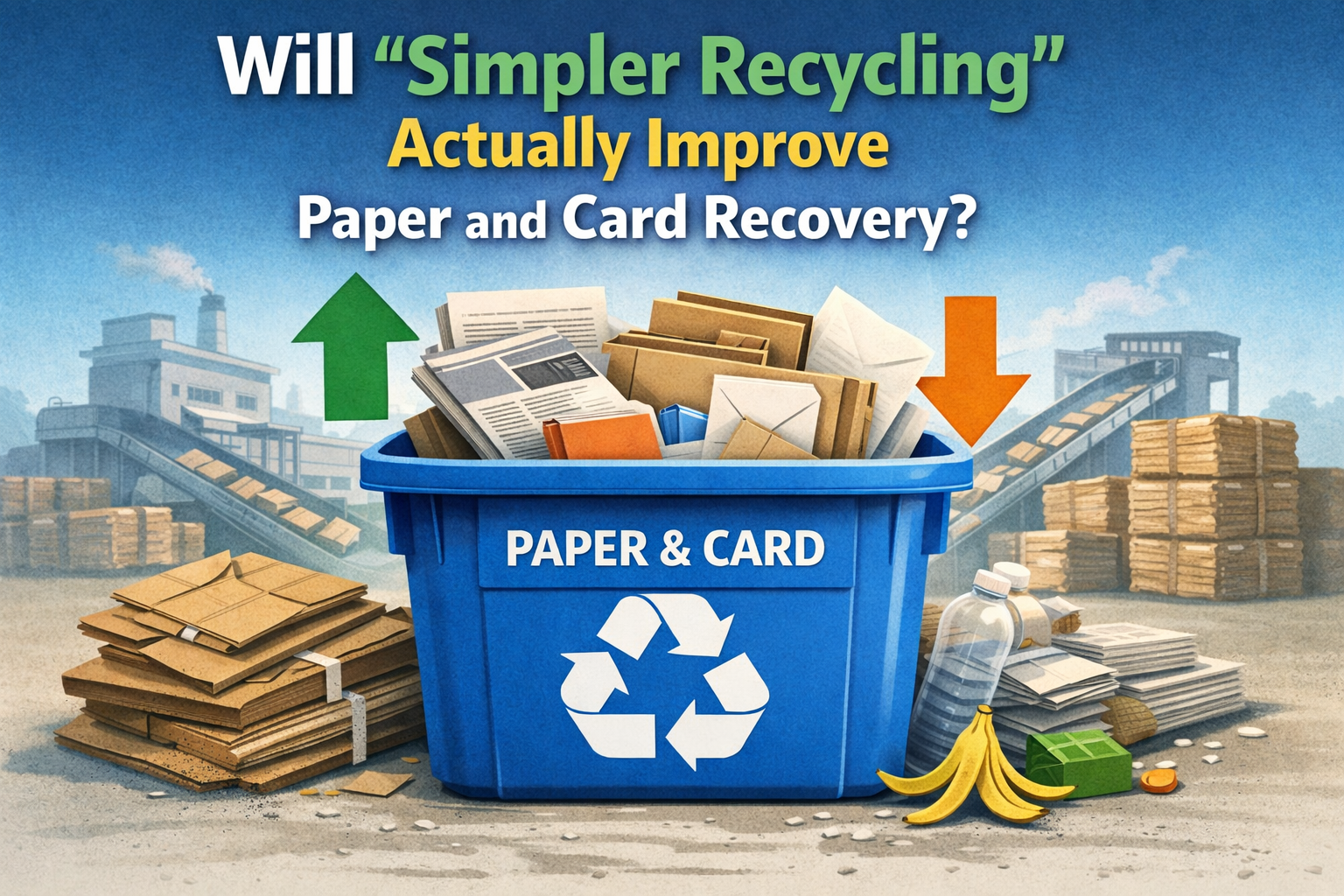
Will “Simpler Recycling” Actually Improve Paper and Card Recovery?
February 26, 2026
The UK’s new Simpler Recycling reforms are set to reshape how waste is collected and processed
across the country. One of the main expectations is a significant improvement in paper and
cardboard recovery rates.

But from an operational standpoint, the real question is: will it deliver measurable results in practice?

The Current Challenge
Paper and cardboard are among the most recyclable materials in the waste stream. However, a large
proportion is still lost due to poor handling and contamination.

Despite high recyclability rates, a notable share of material still ends up:
* in landfill
* or sent for energy recovery

The issue is not availability, it is quality and handling.

Contamination: The Core Problem
In mixed recycling systems, paper and cardboard are often collected alongside:
* food waste
* glass
* plastics

This leads to contamination, making the material unsuitable for recycling.

From an operational perspective, even small contamination levels can:
* reduce material value
* increase rejection rates
* create inefficiencies across the supply chain

What “Simpler Recycling” Changes
The key shift introduced by Simpler Recycling is:
👉 Clearer separation of materials at source, including paper and cardboard

This has several direct benefits:
* Cleaner material streams
* Higher recycling acceptance rates
* Improved processing efficiency
* Better end-product quality

Standardisation across collections will also reduce confusion for businesses and households, an
important factor in improving compliance.

Our Perspective at Quantum Waste
At Quantum Waste, we see Simpler Recycling as a step in the right direction, but not a complete
solution.

1. Separation Only Works with Proper Execution
Introducing separate streams is effective only if supported by:
* correct bin usage
* clear communication
* consistent collection processes

Without this, contamination issues will persist.

2. Operational Efficiency is Critical
Changes at policy level must translate into:
* efficient collection logistics
* well-designed waste streams
* reliable service delivery

This is where real performance gains are achieved.

3. Quality Over Quantity
Recovering more material is important — but recovering usable material is what truly matters.

For businesses, this directly impacts:
* recycling performance
* compliance
* cost efficiency

4. The Role of Waste Management Partners
A structured recycling system only works when supported by experienced operators.

At Quantum Waste, we focus on:

* tailored waste solutions
* clear material segregation
* reducing contamination at source
* maximising recycling outcomes for our clients

Simpler Recycling has strong potential to improve paper and cardboard recovery rates across the UK.
However, its success will depend on:
* how well it is implemented
* how consistently it is followed
* and how effectively it is managed on the ground

Because in waste management, results don’t come from policy alone, they come from execution.

Read more at: https://www.letsrecycle.com/news/will-simpler-recycling-increase-paper-and-card-recovery-rates/?utm_campaign=RWM%20Insights%20Newsletter&utm_medium=email&_hsenc=p2ANqtz-9lzRrexfLzRjwybhoAGtF_IleBPJm1ja69ievYBxFkUHfNgl5CHfJNKVceexCOgwwW8rQoCqkv7lrzRoMb_8zmgxAFow&_hsmi=411347367&utm_content=411347367&utm_source=hs_email