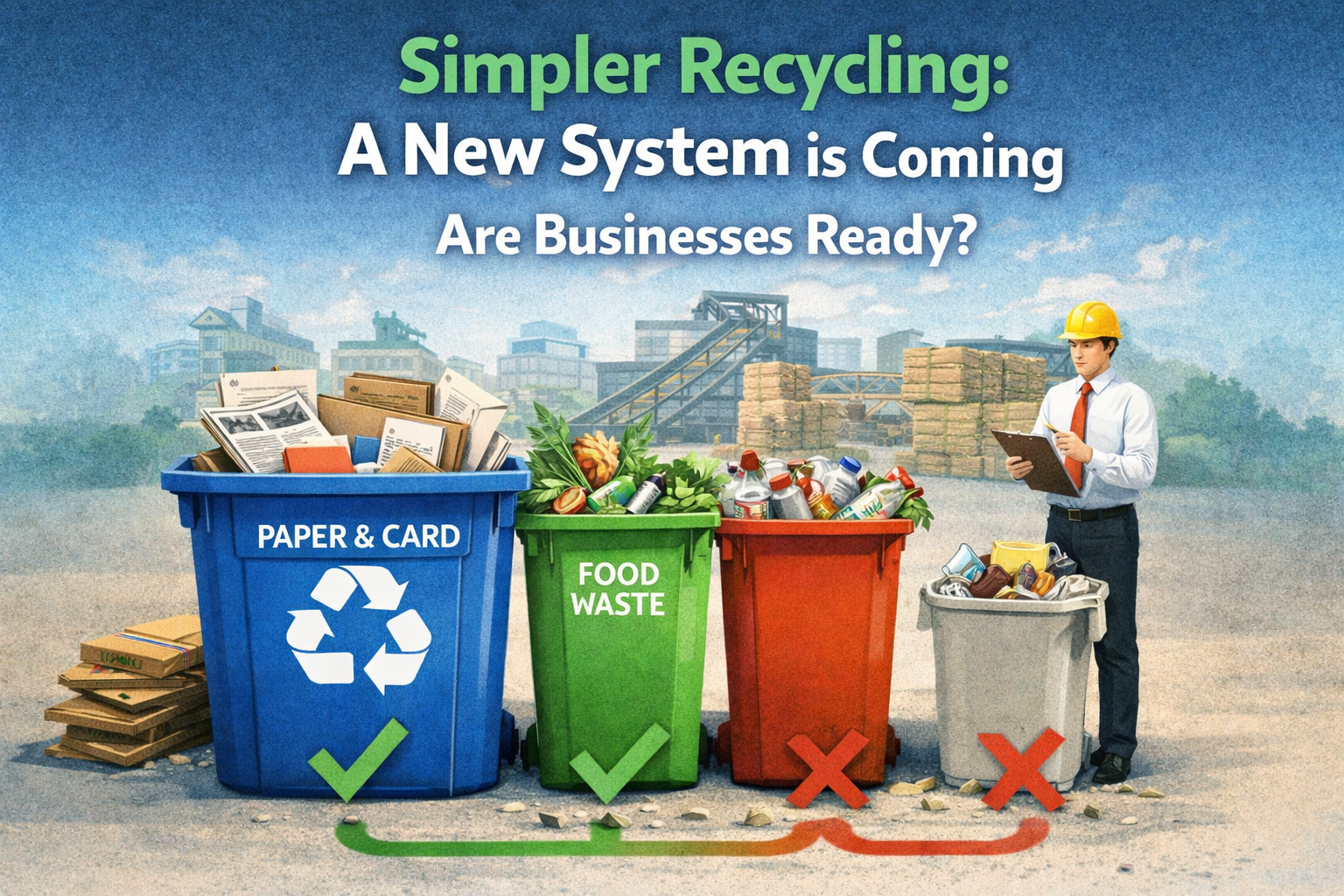
Simpler Recycling: A System Change Is Coming, But Are Businesses Ready?
March 23, 2026
With the rollout of Simpler Recycling across England, the waste sector is entering a new phase, one
that promises greater consistency, improved recycling rates, and better material quality.

But as with any regulatory shift, the real impact will depend on how effectively it is implemented on
the ground.

-- A Major Shift in How Waste Is Managed --
From 2025 (businesses) and now extending into 2026 (households), the UK is moving towards a
standardised recycling system.
This includes:
* separate collection of paper and cardboard
* dedicated streams for food waste
* clear separation of dry recyclables (plastic, metal, glass)
* reduced reliance on mixed waste systems

The objective is simple:
👉 Reduce confusion and improve recycling performance across the country

Historically, inconsistent local systems have contributed to stagnating recycling rates, which have
remained around 44% in England (The Guardian)

The Opportunity: Recovering What Is Already There
One of the most important insights from recent industry data is this:
👉 The issue is not lack of recyclable material, it is loss within the system.

Paper and cardboard represent a significant portion of the waste stream, "around 32% of packaging
material" (greyparrot), yet a large share is still not recovered efficiently.

In fact, nearly 30% of fibre material is still lost to landfill or energy recovery. Contamination remains a
key driver of this loss.

This highlights a critical point for businesses:
Improving recycling is not about generating more waste, it’s about managing it better.

Why Separation Matters
Separation at source is essential because mixed waste streams significantly reduce the quality of
recyclable materials, particularly paper and cardboard. When these materials are contaminated, even
at low levels, they can be rejected entirely, leading to unnecessary waste and increased processing
costs. Cleaner, well-separated streams improve recovery rates, enhance efficiency within processing
facilities, and contribute to a stronger and more reliable recycling market.

The Reality for Businesses
While the policy direction is clear, implementation presents practical challenges for businesses.
Limited space, inconsistent staff compliance, and increased logistical complexity can all affect how
effectively new recycling systems are adopted. Without a structured approach, these changes can
lead to inefficiencies and higher operational costs rather than improved performance.

Our Perspective at Quantum Waste
At Quantum Waste, we view Simpler Recycling as a necessary step forward, but one that must be
supported by strong operational execution. Success depends on setting up the right waste streams,
ensuring clarity in internal processes, and maintaining reliable collection services. Rather than
applying generic systems, we focus on tailored solutions that reflect how each business operates,
helping clients improve material quality while maintaining cost efficiency.

What Businesses Should Be Doing Now
To adapt effectively, businesses should begin by reviewing their current waste setup and ensuring
that key materials such as paper and cardboard are properly segregated. Working with an
experienced waste management provider and implementing clear internal processes will be critical in
meeting upcoming requirements while maintaining operational efficiency.

Simpler Recycling presents a clear opportunity to improve recycling outcomes across the UK, but its
success will depend on how well it is executed in practice. At Quantum Waste, we believe that
effective waste management is built on clarity, consistency, and control, delivering not only
environmental benefits but also stronger operational performance for businesses.

Sources: https://www.theguardian.com/environment/2026/mar/31/rubbish-recycling-england-changes-reforms?

https://www.greyparrot.ai/resources/blog/simpler-recycling-fibre-recovery?